
Most businesses only upgrade their security after suffering a costly break-in, workplace confrontation, or insurance claim. By then, inventory is gone, operations are disrupted, and reactive fixes often miss deeper structural vulnerabilities.
A professional security risk assessment Ontario property owners schedule proactively uncovers blind spots across your physical perimeter, access control, camera coverage, and emergency procedures—allowing you to invest only in protection that actually reduces risk.
Alpha Security Services conducts comprehensive, site-specific security risk assessments for commercial, industrial, healthcare, and residential properties across Ontario.
What a Professional Security Risk Assessment Evaluates
Our senior security consultants evaluate your facility through the eyes of both an intruder and an emergency responder across six critical layers:
- Perimeter & CPTED Review: Fencing integrity, exterior lighting lux levels, landscaping sightlines, roof hatches, and vehicle barrier protection.
- Access Control & Key Management: Visitor sign-in workflows, keycard/fob audit trails, loading dock controls, and after-hours lock-up accountability.
- Surveillance & Intrusion Detection: Camera blind spots, night-vision clarity, NVR redundancy, and alarm sensor coverage.
- Operational & Staff Procedures: Cash handling, lone-worker closing routines, delivery verification, and vendor screening.
- Emergency & Life-Safety Readiness: Fire exit accessibility, evacuation assembly points, and first-aid/AED readiness.
- Local Crime & Industry Threat Profile: Reviewing neighbourhood incident trends across your specific Ontario municipality.
Our 4-Step Risk Assessment Process
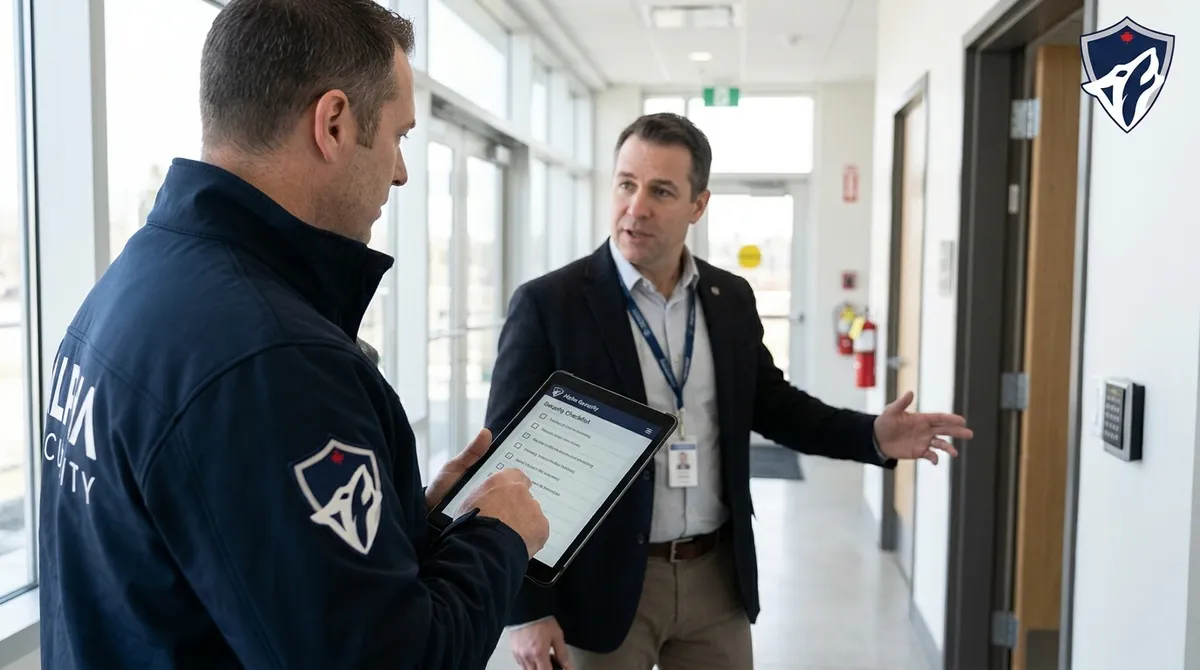
Step 1: Daytime & After-Hours Site Walkthrough
We inspect your property during peak operating hours and evaluate after-hours lighting and perimeter exposure to see how risks shift overnight.
Step 2: Stakeholder & Operations Interviews
We speak with facility managers, reception staff, and shipping supervisors to uncover daily workflow bottlenecks where security rules are routinely bypassed.
Step 3: Vulnerability Scoring & Gap Analysis
Each identified weakness is ranked by likelihood and financial/safety impact so you know which issues require immediate attention.
Step 4: Actionable, Budget-Tiered Recommendations
You receive a clear roadmap detailing quick low-cost procedural fixes alongside recommended physical, camera,or licensed security guard deployments.
When Should Your Organization Schedule a Security Audit?
- Before moving into a new commercial office, warehouse, or retail location.
- Following facility renovations, layout expansions, or changes in operating hours.
- After a near-miss incident, staff safety complaint, or neighbourhood spike in break-ins.
- During annual insurance renewals or corporate compliance audits.
Book Your Ontario Security Risk Assessment Today
With local offices in Mississauga, Kitchener, Hamilton, London, and Trenton, Alpha Security Services provides complimentary initial site consultations and detailed security risk assessments across Ontario.Learn more about our credentials on our security companies overview page.
Take the guesswork out of facility protection—call 1-877-725-7422 or schedule your walkthrough online.
Frequently Asked Questions
Q: How long does an on-site security risk assessment take?
A: For a standard commercial facility or warehouse, an on-site walkthrough takes 60 to 90 minutes, with a written vulnerability summary and proposal delivered within 24 to 48 hours.
Q: Does Alpha Security Services offer free initial security assessments?
A: Yes. We provide complimentary on-site risk walkthroughs for businesses and property managers across Ontario.
Q: Will a risk assessment force us to hire full-time security guards?
A: Not at all. Many recommendations involve simple procedural upgrades, lighting improvements, camera repositioning, or periodic mobile patrols rather than full-time guards.
Q: Can a documented security assessment help with commercial insurance?
A: Yes. Demonstrating proactive risk management and documented security protocols often helps businesses satisfy insurer underwriting requirements.